by Tanya HAFFNER | Jan 23, 2020 | Thoughts, Changing mindset, Event Reports
What’s going to have the most impact on reducing sugar consumption in the UK – educating consumers and encouraging them to change their habits, or changing the environment, reformulation and marketing? Is responsibility ultimately on the individual or industry?
That’s one of the key questions that came out of a panel discussion I was part of at an Action on Sugar event held at Parliament for Sugar Awareness Week.
Campaigners, government officials, health experts and industry experts came together for a networking opportunity all wanting to make a difference, before sitting down to hear from our host Andrew Selous MP, who’s served on the Health Select Committee; Katherine Severi, Chief Executive of the Institute of Alcohol Studies; Professor Graham MacGregor, Chairman of Action on Sugar; and me, asked to speak about how sugar reduction can improve the health of the most vulnerable and what’s our view on industry’s role.
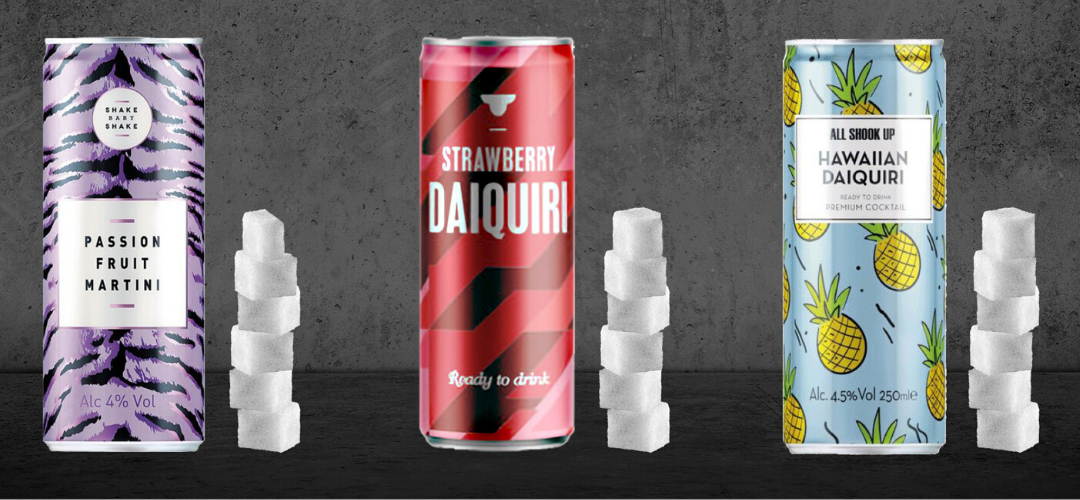
The theme of this year’s Sugar Awareness Week is ‘What’s in your drink’. Action on Sugar have done an excellent job at highlighting a loophole in regulations whereby alcoholic drinks are not obliged to label any nutritional information about their products – even though the calorific and sugar levels are often alarming.
There was universal agreement in the room that something must be done – and everyone can play their part by emailing their local MP to demand change. You can find lots more information on the Action on Sugar website, and I highly recommend you do so.
What, though, will be the ultimate impact of labelling? As Professor MacGregor said yesterday, although labelling and education are a vital step, it’s the environment, formulation of products and marketing that will truly have an impact.
As a nation we are consuming too much sugar on average, which can often mean too many calories, leading to weight gain and obesity. Children, our most vulnerable group, are consuming more than double their maximum recommended allowance of sugar.
In England, around 1 in 4 children have tooth decay and 1 in 3 are overweight or obese by the time they leave primary school.
What’s more, as a 4-5 year old, you’re three times more likely to be overweight or obese if you’re in the most deprived socio-economic group compared to the least deprived: 27.2% vs 17.3%. The results are even worse for 10-11 year olds.
Andrew Selous shared what he discovered on a learning visit to Amsterdam, where the mayor was inspired to do more to reduce child obesity after seeing a girl in a playground who was too overweight to do a forward roll. As the mayor pointed out, if one third of children were suffering from tuberculosis, there would be no avoiding the issue. Action would be taken. The army would be out on the streets helping.
Yet the with obesity comes the complex problem of stigma, shaming and how best to deal with the issue in a ‘publicly correct’ way that’s not going to impact mental health.
What is the role of the wide food industry, retail and out-of-home sectors?
Of course, consumers should make their own choices – and of course we want to encourage them to make good, informed choices benefiting their health and the planet where support for this must continue.
But numerous reports, behavioural change groups and experts globally all concur that if we leave things to individual choice alone, we will not achieve the behavioural change we need to see. We live in environments that are swamped with foods that are high in calories, fat, salt and sugar which are also low in protective nutrients and are heavily promoted to us. Industry has a crucial role to play in providing and marketing healthier choices. Industry can no longer blame poor eating habits on the consumer and their personal choice. It’s especially important for the vulnerable groups, who need the most help.
Examples of positive action for change
An inspiring example from Amsterdam was a supermarket who decided that they didn’t want their consumers to eat unhealthy foods. They changed their environment, made healthier food more accessible, reduced the amount of unhealthy products and made sure the labelling was clear. They had a profit to make but – led by the top – decided that the health of the public was their responsibility too.
Katherine Severi pointed to the action in Scotland to price alcoholic beverages based on the number of units they contained. A 3-litre bottle of cider that previously cost £3.50 went up to over £11 when the law was introduced in May 2018, making it far less accessible to the most deprived.
While it’s too early for full data analysis of the impact, early signs are extremely positive on the positive impact the pricing can have.
What are our recommendations to industry?
1. Stick with the sugar reduction despite the challenges (and ultimately you may have no choice). It makes sense and it’s vitally important to continue to see small subtle incremental reductions in sugar and calories. Reformulation takes time but it IS achievable – we have a precedent with salt reductions.
2. Have a nutrition and health strategy with teeth. It must be:
- Led from the top
- Long-term
- Multi-faceted
- Consistent and joined up across departments and suppliers
- Measured
- Aligned to both health and sustainability
- Communicated and understood right across the business – from CEO to porter
Marketing and external communications should focus on healthier choices, and for optimum impact should incorporate smart partnerships.
We can’t ignore that change has its challenges:
- Industry has to make money. We can’t impact on jobs in these vulnerable times
- There will be growing pains and these need to be listened to, carefully considered and supported
- Change takes time, goodwill and, crucially, support from the top
But there is reason to believe that now, perhaps, there are colliding drivers to move us in the right direction:
- The health of the nation and its impact on socio-economics is stark
- More and more consumer groups are demanding action, for both health and environmental issues
- The financial necessity to change is on the horizon. The likes of Share Action, amongst others, are telling investors that if business don’t change, they will be at risk.
Getting the government to take action
The government said they wanted to half childhood obesity by 2030. That is not going to happen with their current plan.
If our new Government doesn’t have the foresight to act and create the level playing field that industry says it needs, industry needs to get together and lobby for it to be implemented over a reasonable period of time, which at the very least:
- Ensures only healthy products (not high in fat, salt and sugar) to be marketed, promoted and advertised
- Makes uniform colour-coded labelling on front of pack mandatory on all products sold in retail and out-of-home
At the moment, despite all the health and economic imperatives, obesity simply isn’t the top of the agenda.
As each member of yesterday’s panel said, for the sake of our nation’s health and the planet, it’s going to take us all coming together to create a powerful voice and movement for change.
by Tanya HAFFNER | May 25, 2018 | Hot Topics in nutrition, The Nation’s Health
This week, Public Health England (PHE) published their first assessment on the government’s sugar reduction programme, introduced to help reduce rates of childhood obesity.
The food industry – including retailers, manufacturers, restaurants, cafes and pub chains – was given the target to cut 20% of sugar from a range of products by 2020, with a 5% reduction in the first year. The first year of the programme was from August 2016 to August 2017.
What does the assessment show?
- Retailers and manufacturers have achieved only a 2% reduction in sugar.
- Sugar has been reduced by 11% by retailers and manufacturers in drinks that are included in the Soft Drinks Industry Levy and average calories per portion has been reduced by 6%.
- New guidelines have been published for the drinks industry to reduce sugar in juice and milk-based drinks.
Importantly, PHE highlight that there are forthcoming sugar reduction plans from the food industry and that some changes of products were not captured in the data (as the changes took effect after the one-year mark measured). This all points towards hopefully seeing greater reductions in future assessments.
Measuring the progress
Ten food categories were measured that contribute the most sugar to children’s diets, although breakfast pastries and cakes were not included due to insufficient data. Some of the key findings from the assessment include:
- Reductions in sugar levels were seen across five of the categories.
- Yogurts and fromage frais, breakfast cereals, and sweet spreads and sauces have all met or exceeded the initial 5% sugar reduction ambition.
- Biscuits and chocolate confectionary have seen no change at all in sugar levels.
- The puddings category has actually seen a slight (1%) increase in sugar content overall.
- It has been noted that for the eating out of home sector, portion sizes in products likely to be consumed in one go are substantially larger (on average more than double) those of retailers and manufacturers.
- Calories in products likely to be consumed in one go have reduced in four categories. Of these, ice cream, lollies and sorbets, and yogurts and fromage frais have reduced average calories by more than 5%. Often this is due to smaller portion size.
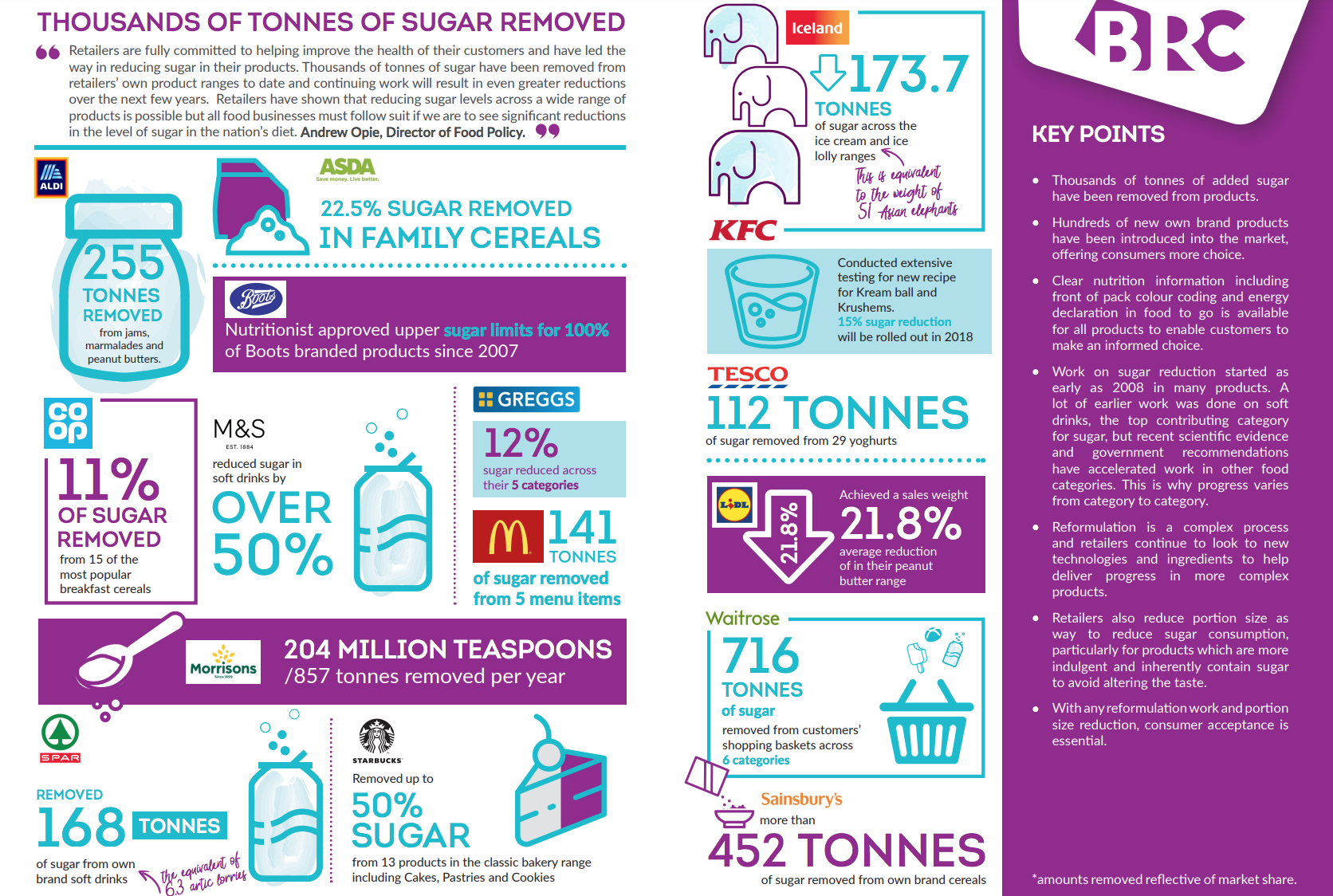
The British Retail Consortium (BRC) provided an interesting infographic showing how the food industry has been cutting sugar.

In response to the PHE assessment, Andrew Opie, Director of Food Policy at the BRC, stated: “Retailers are fully committed to helping improve the health of their customers and have led the way in reducing sugar in their products. Thousands of tonnes of sugar have been removed from retailers’ own product ranges to date and continuing work will result in even greater reductions over the next few years.
“Retailers have shown that reducing sugar levels across a wide range of products is possible but all food businesses must follow suit if we are to see significant reductions in the level of sugar in the nation’s diet.”
The British Dietetic Association‘s Head of External Affairs, Jo Instone, said: “We recognise that there are limitations in the data and that these are the early stages of the reformulation programme. However, it is disappointing to have such significant gaps and for a number of manufacturers to have refused to allow information on their progress to be published.”
“Clearly, it will be important for the BDA, the Obesity Health Alliance and others to continue working with Public Health England and the government to drive this programme forward. We would hope that the 2019 report can fill in a number of gaps and that we will see more substantial progress made across the board.”
Milk based drinks and juice
Following our concern about sugar levels in fruit juice, we’re pleased to see new plans by PHE encouraging the drinks industry to achieve the following by mid-2021:
- Reduce sugar in juice-based drinks by 5% (excluding single juice – that is, products with juice from a single fruit with nothing added to it).
- Cap all juice-based drinks (including blended juices, smoothies and single juices) likely to be consumed in one go to 150 calories.
- Reduce sugar in milk (and milk substitutes) based drinks by 20% and cap products likely to be consumed in one go to 300 calories.
What’s next?
Some progress has been made, but it seems we’re still well off hitting targets for sugar reduction. It’s clear that more work is needed – by manufacturers and retailers, but also cafes and restaurants, where calorie intake tends to be significantly higher.
The next progress report from PHE is due in Spring 2019 and should give a clearer picture on the programme’s progress.
Of course, this is only one of the many strategies needed to help combat the obesity crisis. Along with the BDA and many others, we’re looking forward to hearing government measures for issues including broadcast advertising, in-store promotions and other interventions to help tackle the problem.
by Tanya HAFFNER | Apr 27, 2018 | The Nation’s Health
The new sugar tax on soft drinks excludes fruit juices, as they are legally labelled as having ‘no added sugar’. With child obesity levels ever-increasing, especially among lower socio-economic groups, this worries us.
It also highlights the increasingly frequent and often damaging disconnect between legislation, nutrition science and public health guidance.
Fruit juice is a liquid form of ‘free sugars’, with little of the fibre naturally found in fruit. Additionally, some of the essential vitamins present in fruit juice such as B vitamins, folate and vitamin C are added to fruit juice at the end of processing. So the perception of it as a ‘naturally healthy’ drink is misleading.
Here’s why and when we’re concerned about fruit juice…
Confusing labelling: no added sugar, one of your five a day
‘Added’ vs ‘free’ sugars
With fruit juice packaging labelled with ‘no added sugars’ and the government’s ‘counts as one of your five a day,’ it’s not surprising that consumers perceive fruit juice as better for you than sweetened soft drinks.
EU law permits 100% fruit juice that does not contain any other forms of ‘added sugars’ to be labelled as having ‘no added sugars’.
That sounds logical, right? Except it clashes with the World Health Organisation (WHO) and Public Health England (PHE), who both classify fruit juice as a source of ‘free’ sugars. This is because structure of the fruit has been broken down to release sugars in their free form, which behave in the same way in the body as other forms of more commonly understood ‘free’ sugars, for example table sugar. Like fruit juice, table sugar is simply a result of extracting/freeing naturally occurring sugars from the structure of the beet or cane plant.
The most recent PHE publication in March this year makes things crystal clear, ‘[Free sugars are] all monosaccharides and disaccharides added to foods by the manufacturer, cook or consumer, plus sugars naturally present in honey, syrups and unsweetened fruit juices’.
Vitamins, minerals and fibre in fruit juice
Despite this clear scientific reasoning on sugar, PHE continues to permit 150ml daily allowance of fruit juice to count as one of your five a day.
This is based on the fact that the UK continues to under-consume whole fruit and vegetables, which are critical to meet our essential vitamin C and potassium requirements.
150ml orange juice is equivalent to a medium orange for vitamins, minerals and total sugars. It will provide vitamin C in excess of our requirements and 7-30% of our potassium needs (depending on age), plus vitamin B1 (thiamine). However:
- Fibre: fruit juice 0.1 – 0.9g per 150ml (even one with ‘bits’) vs a medium orange at 1.9g.
- Free sugars: fruit juice 12.3g vs none in a medium orange.
The truth about fruit juice sugars
In terms of free sugars, weight for weight there’s little difference between fruit juice and soft drinks.
|
Amount of free sugars |
% daily free sugars max. recommendations |
| 2-3 yr olds (14g) |
4-6 yr olds
(19g) |
7-10 yr old
(24g) |
11 yr olds and older
(30g) |
| 1 medium (160g) orange |
0 |
0% |
0% |
0% |
0% |
| 150ml pure orange juice |
12.3g |
88% |
65% |
51% |
41% |
| 150ml cola drink |
16.4g |
117% |
86% |
68% |
55% |
| 150ml lemonade |
8.7g |
62% |
46% |
36% |
29% |
Studies looking at fruit juice intakes and impact on health proved challenging for SACN when reviewing their recommendations. Evidence for fruit juice and impact on health was found to be lacking, inconsistent and / or of poor quality.
The problem of portion size
If everyone was to keep to 150ml of a sweetened liquid per day, there would be no issue with fruit juice or sweetened beverages. The problem is, this official advice is given to a nation where it has been found that only 1% of the UK population achieve healthy eating recommendations.This 150ml of sweetened liquid per day will in reality not be followed or achieved by the majority. Not least because it’s difficult to keep to 150ml of fruit juice when, in the main, it is sold in 200ml and 1litre cartons, and most household glasses are around 200-250ml.
Fruit juice is the top contributor to free sugars’ intake for young people
According to the government’s 2018 National Diet and Nutrition Survey, fruit juice remains the number one free sugars contributor for 1½ to 10 year olds. This is highly indicative of mum’s perception that fruit juice, unlike sweetened soft drinks, is ‘natural’, has ‘no added sugars’ and therefore good for their children.
During teen years, sweetened beverages takes prominent first place. Fruit juice drops down to third position but still contributing to almost 10%.
Dental decay
It’s not just weight that’s an issue. The UK has one of the highest incidence of dental caries globally. Dental health is dependent on multiple factors, including the frequency and timing of sugar consumption and length of time teeth and gums are exposed to acidic and sugary foods.
Both fruit juice and sweetened beverages are acidic and contain large amounts of ‘free sugars’. They are therefore not recommended by the British Dental Association (BDA). If fruit juice is to be consumed, the BDA recommends diluting it – 1 part juice to 10 parts water. Despite a common misconception around whole fruit, the BDA highlights that fruit, although acidic, is not a risk to dental health except when consumed in unusually large quantities.
The bottom line is that consumers need to be aware that there is little difference between sweetened beverages and fruit juice when it comes to tooth decay. The recommended drink by all health organisations is either water or milk for optimum health.
What would we like to see?
Free sugars are not essential for human health. Due to our over-consumption, they have become a major contributor to our calorie over-consumption.
However, it would be unrealistic to avoid them altogether, and if consumed in moderation as part of a healthy, balanced diet and lifestyle, there should be no problem at all. The government has set maximum recommended intakes for all ages.
- 0-1 year = no free sugars should be introduced
- 2-3 years = no more than 14g / 3½ tsp per day
- 4-6 years = no more than 19g / 4½ tsp per day
- 7-10 years = no more than 24g / 6 tsp per day
- 11 years plus = no more than 30g / 7 tsp per day
In the context of the current health state of our nation, consumers are struggling with the ‘in moderation’ and ‘balanced diet’ (otherwise obesity and obesity-related diseases would not continue to escalate).We are at crisis point with our unhealthy choices, which are having untold preventable health and economic impacts.
People need clearer advice and support to stop over-consumption and have a healthier understanding and relationship with food and drink.
When it comes to fruit juice, we believe it’s time to start promoting the benefits of consuming real fruit, which provide so much more nutrition, contain no free sugars and very unlikely to be over-consumed.
The law should change to take into consideration international and national classifications of ‘free’ and ‘added’ sugars.
What do you think? Join our discussion on LinkedIn
by Tanya HAFFNER | Apr 16, 2018 | Hot Topics in nutrition, The Nation’s Health
This month, the much anticipated sugar tax came into force in the UK. So what it is, why was it introduced and – most importantly – will it have any impact?
The tax
Soft drinks companies are now required to pay a levy on drinks with certain levels of added sugar:
- 18p per litre of drink if the product contains more than 5g of sugar per 100ml
- 24p per litre if it contains 8g of sugar per 100ml.
The tax does not apply to milk-based drinks, due to their calcium content. It also excludes fruit juice or vegetable juice that don’t have added sugar.
Foods such as cakes, biscuits and other sugar containing foods aren’t covered, but there is a separate initiative to reduce their sugar content by 20% by 2020.
Why was it introduced?
The tax has been introduced in an effort to tackle childhood obesity. The latest National Diet and Nutrition Survey (NDNS) showed that sugar-sweetened drinks are the single highest source of free sugars for children and teenagers. This is why soft drinks have been targeted.
Action already taken by the industry
An estimated 50 per cent of manufacturers have already reduced the sugar content of their drinks to avoid the new tax, including leading brands:
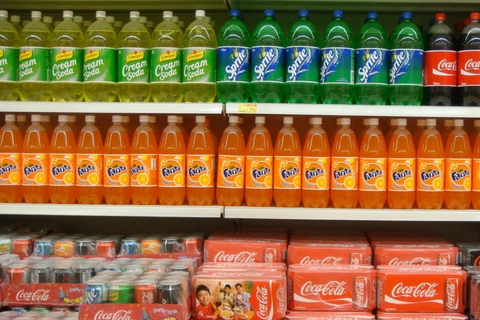
- Fanta – reduced sugar from 6.9g (a little under 2 tsp) to 4.6g (just over 1 tsp) per 100ml.
- Ribena – from 10g (2.5 tsp) to less than 4.5g (just over 1 tsp) per 100ml.
- Lucozade – from 13g (just over 3 tsp) to less than 4.5g (just over 1 tsp) per 100ml.
- Irn Bru – from 10.3g (2.5 tsp) to 4.7g (just over 1 tsp) per 100ml.
Others remain the same, for example Coca-Cola (10.6g per 100ml, just over 2.5 tsp) and Pepsi (11g per 100ml, just under 3 tsp). These manufacturers have to decide whether to bear the cost of the tax increase themselves, or pass it on to consumers.
In one leading supermarket, the cost of a 2L bottle of Pepsi went up by 45p when the tax was introduced. By contrast, Coca Cola kept the price the same but reduced the portion size: a 1.75L bottle has shrunk to 1.5L bottle.
Will it work?
A survey by Mintel of 2,000 people found that just under half (47%) of Brits say that a tax making unhealthy food or drink more expensive would encourage them to cut down on these items. So the measure will hopefully have some effect.
It’s extremely positive that some food manufacturers have already taken action to reduce the sugar content of their recipes. However, the feedback hasn’t always been positive about the new taste of much-loved products (reduced sugar Lucozade and Irn Bru, for example). And a significant proportion of people will simply pay more for the same recipe high-sugar drink they’ve always enjoyed.
We’re also concerned that drinks that fell outside of taxable products, such as fruit juice, often still have high levels of free sugars. The National Health Service discusses maximum intakes of free sugars for all ages.
What happens now?
Drinks manufacturers have made an initial decision on whether to reduce sugar levels to avoid the new taxation or to leave sugar levels unaltered. They’ll be closely monitoring orders from retailers to assess the effectiveness of their initial decision. If it proves that sales of reduced-sugar drinks increases, other manufacturers may be keen to follow suit.
Drinks retailers will need to carefully monitor demand for those reduced-sugar drinks vs unaltered recipes that are subject to the tax, to satisfy any changes in demand.
The Mintel research found that three quarters of consumers say that easier-to-understand nutritional information on product packaging would encourage them to cut down on unhealthy food/drink. We’d love to see improved labelling too, to see what the impact could be.
Takeaway message
It’s going to take months and years to assess the impact the tax has on the nation’s health. And, of course, obesity is caused by many factors. Clearly multiple strategies including education will be needed to combat the problem. We’ll be monitoring closely to see whether the action has any impact on those most affected by obesity – those in the lower socio-economic bracket and children.
Do you agree it’s a step in the right direction? Should the Government be focussing on something else to better address the problem?
by Tanya HAFFNER | Jan 24, 2018 | Thoughts, Media in context, The Nation’s Health
Each week we analyse some of the hot headlines in health and nutrition news. This week we look at the health effects of energy drinks; and a new report from Cancer Research UK on unhealthy food advertising for children.
HEADLINE 1: MORE THAN HALF OF YOUNG PEOPLE SUFFER SIDE EFFECTS FROM ENERGY DRINKS
This week the adverse effects of energy drinks have been reported by the Daily Mail, the Independent and The Sun.
The headlines are based on a study published in the Canadian Medical Association Journal. It carried out an online survey of 2,055 children and young adults aged 12-24, who were asked about their consumption of energy drinks and coffee, and any adverse outcomes they experienced.
55.4% of those who had ever consumed energy drinks (no more than 2 drinks per day) had experienced at least one adverse effect. The most common were fast heartbeat (24.7%), difficulty sleeping (24.1%) and headache (18.3%). Few reported nausea/vomiting/diarrhoea (5.1%), chest pain (3.6%) or seizures (0.2%). 3.1% of the respondents had sought medical advice.
The side effects were consistent with the potential effects of caffeine but were significantly more prevalent than with those who’d reported effects from coffee.
Behind the headlines: the Nutrilicious dietetic view
There are significant limitations to the study, making it impossible to draw any clear conclusions or new insights into the impact of energy drinks on health:
- The quantifies of caffeine consumed were unknown
- Medical history was not recorded.
- The authors admit that there were many other compounding factors to the side effects, such as alcohol and drug consumption.
- They also acknowledge difficulty with under- and over- reporting.
What the study does highlight, however, is the popularity of energy drinks among young people.
So what is considered ‘safe’ when it comes to energy drink consumption?
How energy drinks could affect your health
- The impact of caffeine
Caffeine is phytochemical stimulant of the central nervous system. It is naturally found in coffee, cocoa beans and tea leaves.
The effects of caffeine vary greatly between habitual drinkers and non-caffeine consumers, who may consume a one off-caffeine drink.
Habitual healthy caffeine drinkers consuming moderate amounts would not experience negative side effects from caffeine. Sugar-free variants will count towards hydration, improved sports performance and alertness.
As with all foods and drinks, moderation is key. Safety limits on daily intakes have been set by the UK based on European Food Safety Authority (EFSA) guidelines:
- For healthy adults (aged 16+, excluding pregnant and breastfeeding women): No more than 400mg caffeine per day (3-4 cups of coffee or 2-4 cans of energy drinks, depending on the size of the can). No more than 200mg caffeine (2 cups of coffee or 1-2 energy drinks) as a single dose. Some adults may be sensitive to caffeine. For them, single doses of 100mg may result in difficulty sleeping and reduce sleep duration, particularly when consumed close to bedtime.
- For pregnant and breast-feeding women: No more than 200mg per day (1-2 cups of coffee, 1-2 energy drinks). Doses greater than this have been associated with increased risk of miscarriage and lower birth weights
- For under 16s: Up to 3mg/kg body weight daily intakes of caffeine do not raise safety concerns. For a 14-year-old teenager weighing 51kg, this would equate to around 153mg of caffeine (1-2 cans energy drink).
- Taurine and other energy drinks constituents: EFSA’s 2015 scientific review found no evidence for safety concerns with regard to the interaction between caffeine and other energy drink constituents such as glucuronolactone and taurine.
- Increasing free sugars in the diet – the bigger concern
The more popular energy drinks are loaded with free sugars. Even if drunk in moderation in terms of caffeine content, the free sugars content will impact negatively on health.
A typical 250ml serving provides 27.5g sugars (7 teaspoons). That’s 92% of the recommended daily intake for children aged 11 upwards and exceeds daily recommendations for 7-10 year olds by 3.5g.
These drinks are nutrient poor and energy rich, providing excess energy that our young do not need in our current environment of increasing obesity and micronutrient deficiencies.
Of major concern is the larger 500ml serving size of some energy drinks. These can exceed not only the daily caffeine recommendations for teenagers and young children (160mg per 500ml) but also the free sugars recommendation. One brand provides 80g free sugars per 500ml can. That’s three times the daily recommendation of free sugars for 7-10 year olds and 2.5 times for older children and adults.
Take home message
Sugar-free energy drinks containing caffeine can be drunk in moderation. They contribute to hydration, improve alertness and do not have any negative health implications. Habitual moderate caffeine consumption is perfectly safe. Large sizes loaded with sugar do not play a part in a balanced diet.
For more advice on healthy drink choices, go to the NHS website
HEADLINE 2: CANCER RESEARCH UK ARGUES LINK BETWEEN TV ADS AND CHILDHOOD OBESITY
This week, Cancer Research UK called for a ban on advertisements for high fat, salt or sugar (HFSS) foods during talent shows and live sports. This was picked up by the Daily Mail and the Express, as well as BBC’s Newsnight.
It follows their online survey involving 3,348 young people aged 11–19 years, a representative sample of the UK population. Comparisons were made between high commercial TV viewing (three hours per day or more) versus moderate (0.5-3 hours per day).
12 HFSS foods were investigated (confectionery, desserts, flavoured yogurts, cakes/biscuits, milk drinks, takeaways, sugary drinks, sweetened cereals, energy drinks, fried potato products & crisps).
See full details of the report and the methodology used
Key findings include:
- There was a significant increase in junk food consumption with the higher viewing of advertisements – 520 more junk food items were consumed per year for each child by those in the high vs moderate TV viewing group.
- Those in the high TV viewing group were more likely to have a greater overall HFSS food consumption across 10 out of the 12 HFSS foods investigated.
- Key times of exposure to junk food advertisements were in the evenings and weekends, i.e. not classified as ‘children’s viewing time’.
This is of relevance because currently advertising HFSS foods is banned during programmes aimed at children (introduced in 2008 – a decade old!), but the ban does not apply to later mainstream programmes such as live sport and talent shows. The TV regulator, Ofcom, have previously highlighted that 7-8pm is when children currently watch the most TV.
- Junk foods ads were equally effective on TV and on demand streaming.
As a result, Cancer Research UK is calling for restrictions up until 9pm on TV and tighter controls for online streaming.
Behind the headlines: the Nutrilicious dietetic view
This is a detailed survey from Cancer Research UK, involving a large number of participants and provides evidence (although not causal) that HFSS marketing could be driving unhealthy eating and drinking.
The lead researcher Dr Jyotsna Vohrarom Cancer Research has stated: ‘This is the strongest evidence yet that junk food adverts could increase how much teens choose to eat.’
It has been shown that high consumption of individual foods including takeaways, sugary drinks and confectionary items are linked to increased BMI in children and young adults.
While this report does not directly show that HFSS marketing causes childhood obesity, Cancer Research UK have announced that alongside other reports, they will release a report later this year investigating the link between marketing and weight.
The problem of childhood obesity
Childhood obesity is a huge public health issue in the UK, with nearly a third of children aged 2 to 15 years classed as overweight or obese. An obese child is five times more likely to become an obese adult. In the short term this can cause physiological and psychological harm and long term, negative health effects and the risk of cancer increases. See more details on our blog Behind the Headlines 11th December.
Take home messages
This year, much action is being taken to help combat the obesity crisis, including the sugar tax, calls for sugar reduction in foods, campaigns on children’s snacking and more – as discussed on the Government’s website.
This new report highlights that HFSS marketing poses a risk for consumption of unhealthy foods, which through excess calories could contribute to obesity.
It also shows that HFSS advertisements were viewed during family shows in evenings and weekends, which should be exempt based on the new Advertising Standards Authority (ASA) and the Committee of Advertising Practice (CAP) regulations (see our blog New rules on food advertising to help tackle childhood obesity.
We hope this important report will put pressure on Ofcom and the Government to enforce tighter regulations for HFSS marketing, furthering the fight against childhood obesity.
Policy recommendations as a result of the research are discussed in the full report.